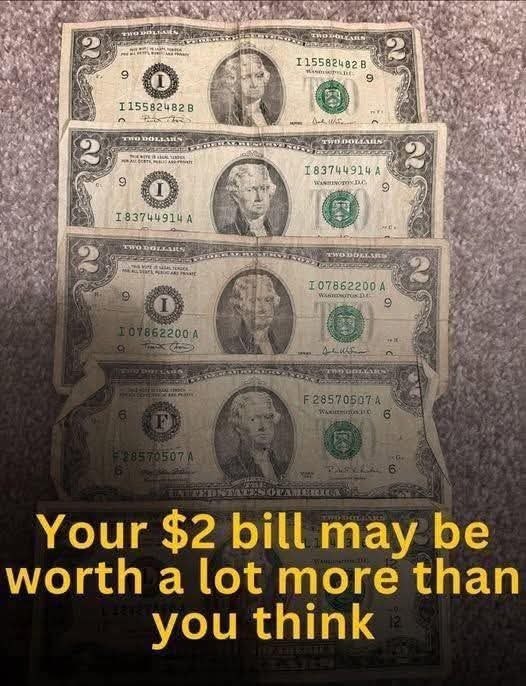
For many years, the American two-dollar bill has occupied an unusual place between everyday currency and popular myths. Some people believed it was unlucky, while others assumed it was no longer in circulation. In reality, the bill remains legal tender, and in certain situations, it can be worth more than its printed value, especially to collectors.
The two-dollar bill was never banned or officially discontinued. Its limited use came mainly from low demand, as many people preferred other denominations and some businesses avoided keeping it in their registers. Because it appeared less frequently in daily transactions, it gradually gained a reputation for being rare, which led many people to save it rather than spend it.
Most modern two-dollar bills, particularly those issued after 1976, are generally worth their face value unless they are in excellent condition or have distinctive features. Collectors often pay attention to unique serial numbers, such as repeating digits, very low numbers, sequential patterns, or symmetrical designs. Even newer bills can attract interest if they are well preserved and visually unusual.
Older two-dollar bills are often more desirable, especially those from the early twentieth century that feature red or brown seals. Printing errors can also increase value, depending on rarity and condition. If you come across a two-dollar bill, it may be worth taking a closer look at its year, condition, seal color, and serial number before spending it, as it could have added interest for collectors.