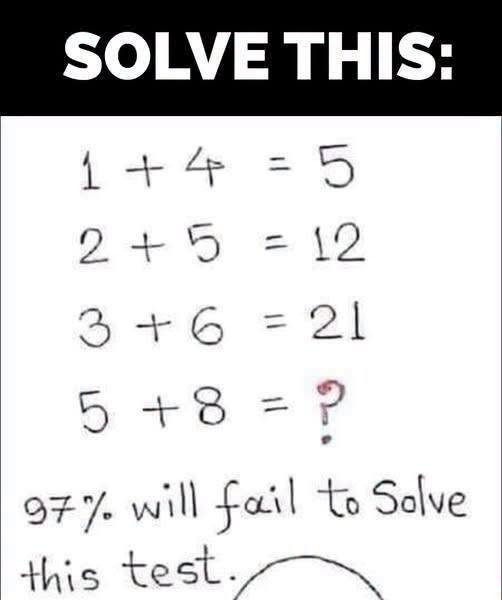
Some math puzzles are difficult because they require advanced formulas or lengthy calculations. Others are challenging because they look deceptively simple. Number-pattern puzzles are entertaining for this reason: they present a short sequence, ask you to identify the hidden rule, and leave room for more than one interpretation. One popular example is: 1 + 4 = 5, 2 + 5 = 12, 3 + 6 = 21, and 5 + 8 = ?
At first, the equations appear to involve ordinary addition, but the displayed answers do not match standard calculations. This suggests that another rule is being used. One possible pattern combines the numbers in each line with the previous result. Under one interpretation, the sequence can lead to 45. Another approach adds the previous answer to the next equation: 2 + 5 + 5 = 12, followed by 3 + 6 + 12 = 21. Using that method, the final equation becomes 5 + 8 + 21 = 34.
So which answer is correct? The puzzle does not provide enough instructions to establish one definite solution. Different solvers may identify multiplication patterns, repeated addition, previous-result relationships, or even alternative number systems. This flexibility can produce answers such as 32, 111, or 1101. However, not every answer is equally convincing. The strongest solution is usually the rule that explains every line consistently while requiring the fewest assumptions.
The puzzle offers an important lesson about mathematical reasoning. Start with the simplest relationships, examine what changes between lines, and determine whether each result depends on the displayed numbers alone or on earlier answers. If you reached 45, 34, or another result, your answer may reflect a different rule rather than an automatic mistake. The real challenge is not only finding an answer, but explaining the pattern that supports it.