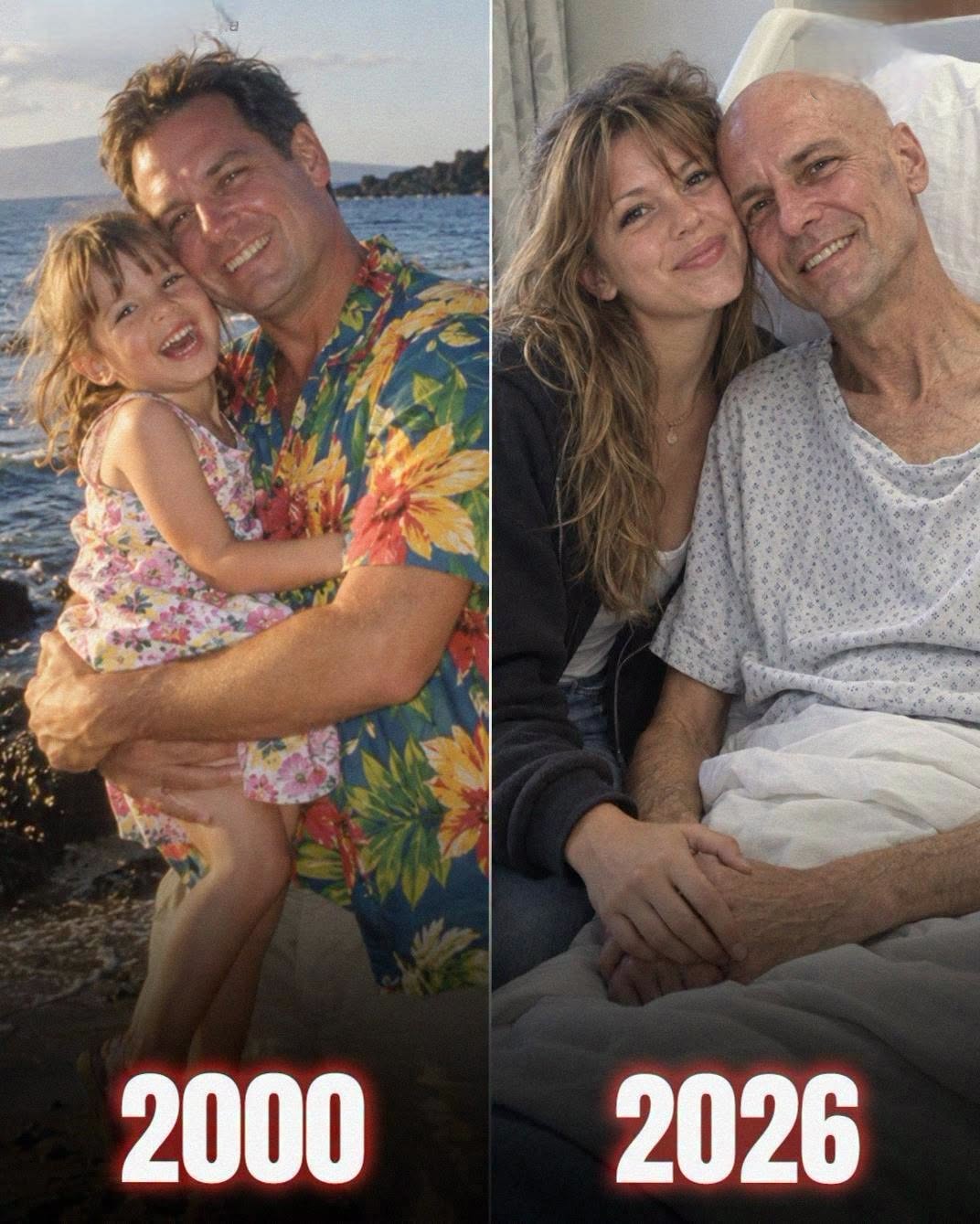
“The pancakes were always shaped like stars,” I told the nurse.
She gently adjusted the blanket covering Frank’s legs and checked the equipment beside his bed. He had been resting for most of the afternoon, his breathing quiet and slow.
“The pancakes were always shaped like stars,” I repeated. “Even when I was grown, married, and bringing my own daughter to visit, he still used that little metal cutter.”
Frank slowly opened his eyes.
I leaned closer.
“Dad?”
He looked at me, and instead of giving me his usual smile, his eyes filled with tears.
“Are you uncomfortable?” I asked.
He shook his head.
The nurse gave us a gentle smile before stepping outside to give us some privacy.
I picked up the cloth beside the bed and carefully wiped his forehead.
“You know those pancakes weren’t even that good,” I said, trying to make him smile. “They were always a little too brown around the edges.”
A faint smile appeared on his face.
“You still ate them,” he whispered.
“Of course I did.”
For a moment, everything felt normal.
Then Frank looked at me differently.
“I need to tell you something,” he said.
I held his hand.
“What is it?”
He took a slow breath.
“I haven’t told you the whole truth about your childhood.”
I smiled nervously.
“Dad, you don’t need to worry about anything right now.”
“No.” His voice was weak but determined. “You need to hear this.”
I moved closer.
“I’ve kept something from you for most of your life.”
My heart began beating faster.
“What kind of thing?”
Frank reached beneath the blanket and pulled out a small folded piece of paper.
“There is an address written here.”
I looked at it.
“Why?”
“You need to go there.”
“Dad, I’m not leaving you.”
“You have to,” he whispered. “Please.”
I stared at him, completely confused.
“Tell me what this is about.”
He closed his eyes for several seconds.
“Some things are easier for another person to explain.”
Those were the last complete words he spoke to me.
Frank had married my mother when I was four.
I didn’t immediately accept him.
I didn’t call him Dad.
I barely spoke to him.
He never forced the issue.
Instead, he patiently learned the little things that made me happy.
He learned that I liked strawberry jam spread all the way to the edge of my toast.
He learned which stories I wanted to hear before bed.
When thunderstorms frightened me, he would sit outside my bedroom until I fell asleep.
And every Sunday morning, he made apple pancakes.
He had an old metal cutter shaped like a star, and he used it to turn ordinary pancakes into something special.
One morning, I walked into the kitchen, climbed onto a chair, and called him Dad without even thinking about it.
He froze.
The spatula slipped from his hand.
Neither of us said anything.
He simply placed a pancake on my plate and smiled.
From that morning forward, I never questioned who he was to me.
He was my father.
My mother died when I was still very young.
After the funeral, our house became crowded with relatives and quiet conversations.
People wondered what would happen to me.
Some suggested that another family member should raise me.
I listened from a distance.
One morning, I hid beneath the kitchen table because I didn’t want to hear anyone talk about my future.
Frank eventually found me.
He sat down on the floor beside me.
“Are you leaving?” I whispered.
His expression changed immediately.
“No.”
“Everybody leaves.”
Frank reached toward me and held out his little finger.
“I won’t.”
“Promise?”
“I promise.”
That promise became one of the most important things in my life.
And he kept it.
Frank walked me down the aisle when I got married.
He held my daughter’s hand when she was born.
He came to birthday parties, school events, family dinners, and ordinary Sunday breakfasts.
Whenever I asked about his life before my mother, he always gave me the same answer.
“The important part began when you came along.”
I thought those words were simply a sweet thing for a father to say.
I never realized there was an entire story behind them.
Years passed.
Frank eventually became ill, and his health gradually declined.
During his final days, I stayed beside him as much as I could.
I wasn’t prepared for how difficult it would be to see the man who had always seemed so strong become tired and fragile.
On the final afternoon, he gave me the address.
I didn’t want to go.
But something in his expression told me that I needed to understand.
So I drove there.
The house was less than twenty minutes away.
An older woman opened the door.
The moment she saw me, she became completely still.
“Rosalie?”
I stared at her.
“How do you know my name?”
“My name is Caroline,” she said.
She stepped aside.
“Frank told me you might come.”
I followed her inside.
“Who are you?”
Caroline looked toward a small cabinet.
“I was one of Frank’s closest friends many years ago.”
Then she opened a drawer.
Inside were several old kitchen items.
Among them was a small metal star-shaped cutter.
I immediately recognized it.
“That belongs to my father.”
Caroline nodded.
“He had another one.”
She picked up a photograph.
My breath caught.
A much younger Frank stood beside a little girl at a kitchen table.
The girl was smiling beside a plate of star-shaped pancakes.
“Who is she?” I asked.
Caroline sat down.
“Her name was Miley.”
I waited.
“Miley was Frank’s daughter.”
I couldn’t speak.
“What?”
“Frank had a daughter before he met your mother.”
I stared at the photograph.
“She died when she was very young.”
Caroline spoke gently, explaining that Miley had been Frank’s child from an earlier marriage. Her passing had changed him profoundly, and his marriage eventually ended.
“He kept the photographs,” Caroline said. “But he rarely spoke about her.”
I looked again at the pancake cutter.
“The pancakes…”
Caroline nodded.
“They were Miley’s favorite.”
I felt tears gathering in my eyes.
“Why did he never tell me?”
“Because he didn’t want you to feel as though you were taking someone else’s place.”
I looked at her.
“What do you mean?”
“He never saw you as a replacement for his daughter.”
She paused.
“He saw you as yourself.”
That sentence stayed with me.
Caroline continued.
“When you were little, you reminded him of the love he had once experienced as a father. At first, that frightened him. He was afraid of becoming attached again.”
I remembered something Frank had told me many years earlier.
Every time I laughed, he would smile and say that my laughter made the whole house feel brighter.
I had never understood how meaningful that was to him.
Caroline told me that after my mother died, Frank had struggled with the responsibility of raising me alone.
“He came here after the funeral,” she said.
My heart sank.
“Why?”
“He was overwhelmed. He wasn’t sure he was capable of raising another child while carrying so much grief.”
I stared at her.
“Did he plan to leave?”
“For a short time, he thought about it.”
The answer hurt.
But Caroline continued.
“He didn’t stay because someone forced him to. He stayed because he realized that you needed him, and because he loved you.”
I remembered the promise beneath the kitchen table.
“I thought he never considered leaving.”
“He didn’t want you to know about that struggle,” Caroline said. “He believed children shouldn’t have to carry the fears of adults.”
I lowered my head.
“So that was the lie?”
Caroline shook her head.
“I don’t think he ever meant it as a lie. He simply chose not to tell you everything.”
She handed me the photograph.
“He wanted you to remember him as your father, not as a man who once struggled with fear and uncertainty.”
I looked down at the picture.
Frank was smiling beside a little girl I had never known.
Then I thought about another photograph somewhere in his wallet.
A picture of me.
Suddenly, I understood.
He hadn’t erased one daughter to make room for another.
He had carried both memories with him.
I drove back to the hospital.
The photograph sat safely beside me.
I wanted to tell Frank that I understood.
I wanted him to know that the truth hadn’t changed anything.
If anything, it made me appreciate him even more.
When I reached his room, the nurse was standing outside.
She looked at me quietly.
I knew before she spoke.
My father was gone.
I walked to his bedside and held his hand.
“You should have told me,” I whispered through my tears.
“Not because I would have loved you less.”
I paused.
“Because I would have loved you even more.”
The nurse placed a small bag of his belongings beside me.
Inside were his wallet, watch, and keys.
I opened the wallet.
Behind his identification was a photograph.
It was Miley.
Beside it was another photograph.
It was me as a little girl, holding a crooked star-shaped pancake.
I stared at both pictures.
For years, I had wondered whether Frank had ever been able to move beyond his past.
Now I realized he hadn’t needed to.
He had simply learned how to carry it.
That evening, I went home.
My daughter was waiting for me.
“Is Grandpa coming home?”
I hugged her.
“No, sweetheart.”
She understood.
We sat quietly together for a while.
Then I went into the kitchen.
The old star-shaped pancake cutter was in the drawer.
I took it out.
My daughter watched as I prepared the batter.
“Why did Grandpa always make pancakes like that?”
I smiled through my tears.
“Because they reminded him of someone he loved.”
She looked at the little metal star.
“Who?”
“Someone from his past.”
I poured the batter into the pan.
When the pancake was ready, I placed it on her plate.
She took a bite and smiled.
For a moment, I could almost hear Frank laughing in the kitchen.
Not because the past had disappeared.
Not because grief had suddenly become easy.
But because the traditions he had created were still alive.
The next Sunday, we made star-shaped pancakes again.
And the Sunday after that.
I kept the little metal cutter in the kitchen.
It became more than an old utensil.
It became a reminder that families are sometimes built through promises, patience, and everyday acts of love.
Frank had entered my life when I was four.
He wasn’t my biological father.
But he was the man who stayed.
He was the man who held my hand through childhood, walked beside me into adulthood, and left me with a lifetime of memories.
And in the end, I learned something important about him.
He hadn’t hidden his past because he was ashamed of me.
He had hidden it because he wanted me to know that I had never been second place in his heart.
I was simply his daughter.
And he was always my dad.