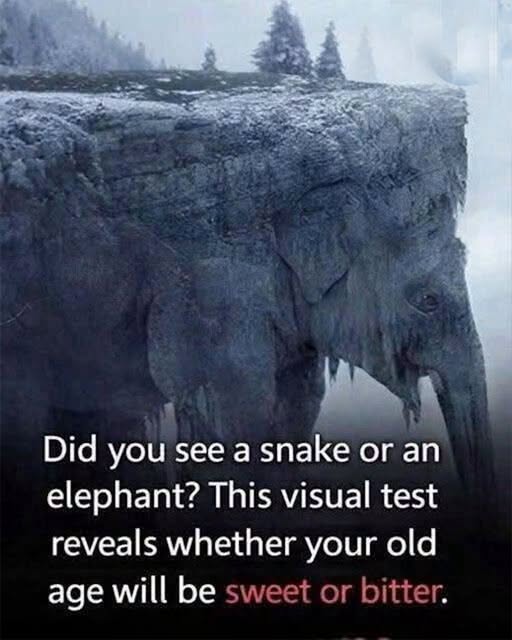
The snake-and-elephant optical illusion offers an entertaining way to explore how people interpret the same image differently. Those who notice the snake first are playfully associated with attention to detail, awareness of potential risks, and sensitivity to change. People who recognize the elephant first are linked with broader thinking, loyalty, wisdom, and emotional strength.
Seeing both animals may suggest an ability to consider multiple perspectives. Such individuals are often described as adaptable, empathetic, and open-minded, although they may occasionally struggle with indecision. Those who see neither are characterized as practical thinkers who prefer straightforward information, although they might overlook less obvious possibilities.
The illusion demonstrates ambiguous figure perception, where identical visual information supports different interpretations. Attention, expectations, previous experiences, and familiarity with shapes can influence what appears first. Symbolically, snakes are associated with transformation, healing, wisdom, and danger, while elephants commonly represent strength, stability, loyalty, and endurance across different cultures.
However, these associations are intended for entertainment rather than scientific personality evaluation. An optical illusion cannot reliably determine intelligence, character, or future behavior. Its greatest value lies in demonstrating how perception varies between individuals. Looking again and considering alternative interpretations can encourage curiosity, flexibility, and a better appreciation of different viewpoints.