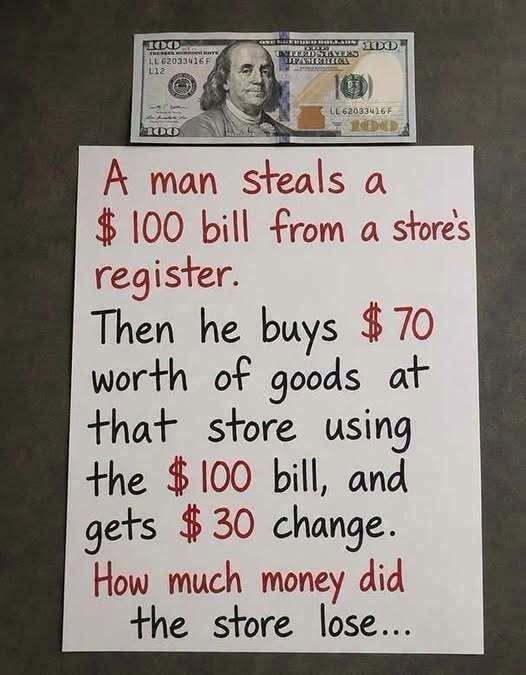
A familiar puzzle describes a man stealing $100 from a store register. He later returns and uses that same bill to purchase merchandise worth $70.
The cashier accepts the stolen bill and gives him $30 in change. This seemingly straightforward transaction raises a question about the store’s actual financial loss.
Some people calculate a $200 loss by adding the original theft, merchandise, and change. However, this approach mistakenly counts the same stolen money more than once.
Others suggest the store loses nothing from the original theft because the bill returns. Yet this explanation overlooks the merchandise and additional cash the thief receives.
Initially, the store loses $100 when the money disappears from its register. When the thief spends that exact bill, the missing cash effectively returns to circulation.
However, the cashier provides $70 worth of merchandise and $30 in change. These items represent the actual value the thief takes away following the completed transaction.
The essential detail is avoiding double counting. Since the original $100 returns to the register, it cannot also be treated as an additional loss afterward.
Therefore, the correct answer is $100, consisting of $70 in merchandise and $30 in cash. The puzzle demonstrates why carefully following transactions prevents misleading calculations.