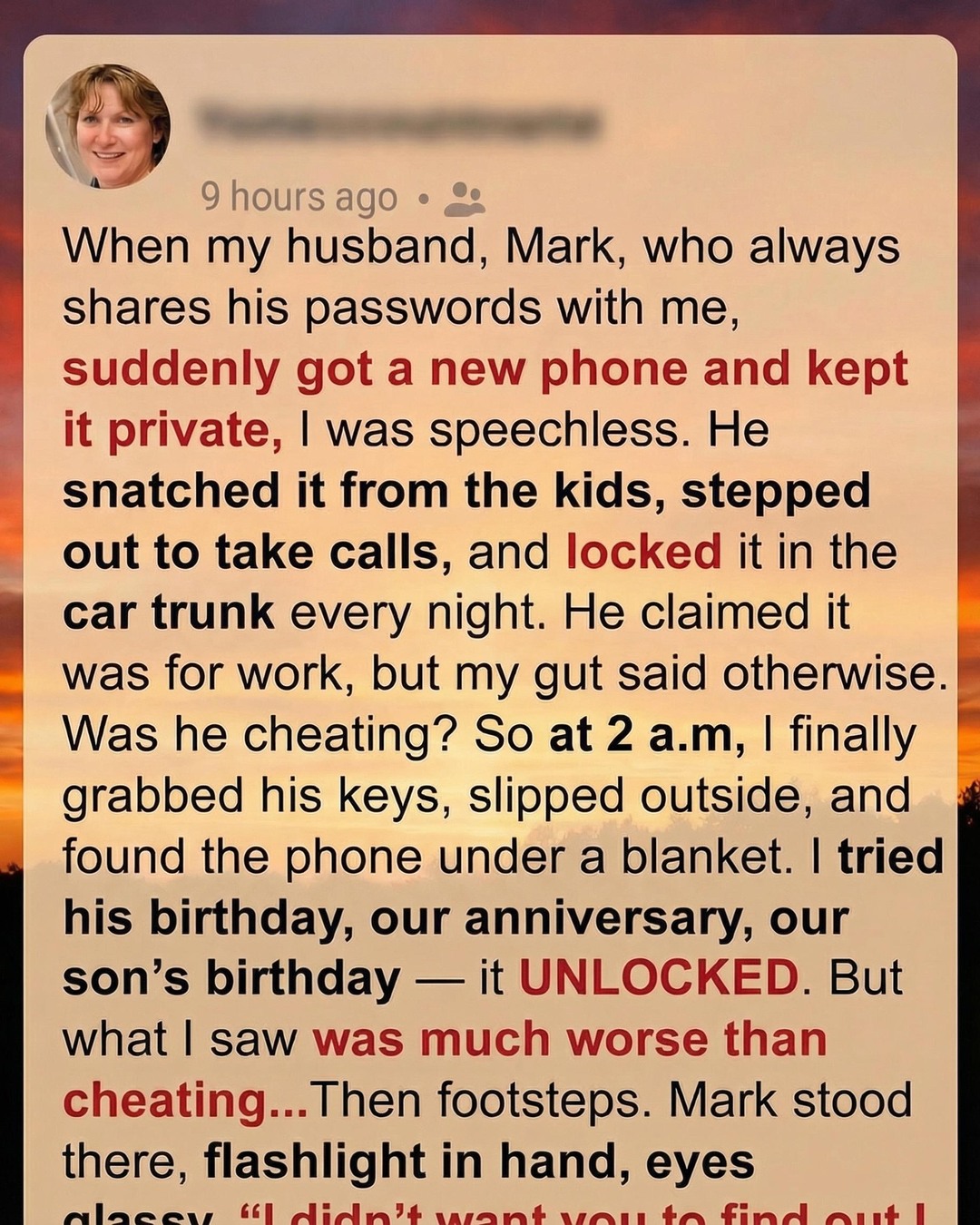
Sometimes a marriage changes not through dramatic events, but through small shifts that quietly make you uneasy. That’s how it began with Mark. For years, he had always been open with his devices and conversations, never thinking twice about sharing them. Then everything changed. He bought a new phone and became unusually protective of it. He stepped outside for calls, kept the phone out of reach, and locked it in the car trunk at night as if it required constant privacy. His explanation—“It’s work-related”—felt incomplete. A persistent worry grew inside me, and after many nights of uncertainty, I finally decided to look for answers. At 2 a.m., I walked outside, unlocked the trunk, and found the phone under a blanket. When his usual passcode opened it, I thought I was prepared for anything—yet the truth was completely unexpected.
As soon as I turned on the screen, footsteps sounded behind me. Mark stood in the driveway holding a flashlight, looking more exhausted than upset. When he quietly said, “I didn’t want you to discover why…,” my heart stopped for a moment. What followed was not a confession of disloyalty but something much heavier. He explained that the messages, late calls, and hidden contacts had nothing to do with another relationship. They were conversations with doctors, specialists, and support resources. For months, he had been dealing with concerning symptoms and undergoing evaluations he didn’t fully understand. Instead of confiding in me, worry pushed him into silence. He thought he was protecting our family from stress while he searched for clarity on his own, but the answers never came quickly, and the secrecy grew into something that looked misleading from the outside.
Standing there in the quiet driveway, the truth felt heavier than any suspicion I had imagined. I wasn’t looking at someone being unfaithful—I was looking at someone overwhelmed and frightened, carrying his uncertainty alone so he wouldn’t worry the people he cared about. He showed me the messages—appointment reminders, notes he had saved, and questions he hadn’t yet voiced. Suddenly, all his unusual behaviors made sense: stepping outside so the kids wouldn’t overhear, deleting messages that might cause concern, and locking the phone away so no one stumbled upon something upsetting. It wasn’t secrecy driven by dishonesty—it was silence shaped by fear. And the moment he expressed how overwhelmed he had been, my worry shifted into understanding.
We ended the night sitting together on the front steps, speaking more openly than we had in a long time. He apologized for keeping me at a distance, and I apologized for assuming the worst. We agreed that facing something uncertain alone only increases the fear. From then on, the phone stayed inside, no longer hidden away. We made lists of questions for future appointments, looked into information together, and promised to share concerns instead of carrying them separately. What I feared might distance us became the moment that strengthened our connection. That night reminded us both that trust is not about being strong alone—it is about allowing someone to stand with you when life feels uncertain.