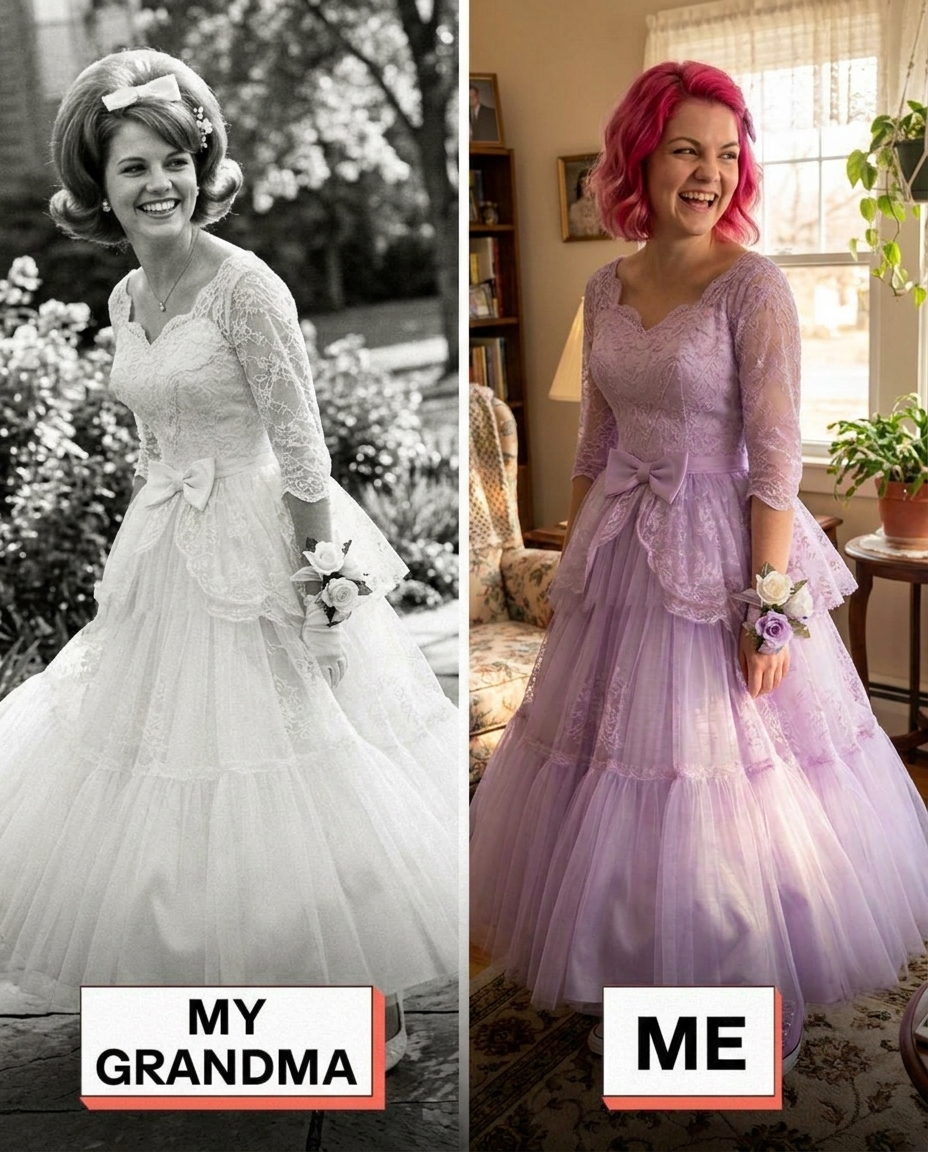
I always thought my nineteenth birthday would be remembered for something simple and meaningful—the first blueberry pie I made on my own, following my grandmother’s recipe step by step. Instead, it became the day I lost her. One moment I was walking in to surprise her, and the next I was standing beside her, realizing she was gone. The house quickly filled with people, voices, and movement, but everything felt distant. The only thing I could hold onto was the home we shared and the memories inside it. When I later found her old blue prom dress tucked carefully in the closet, it felt like more than coincidence. Wearing it to her funeral seemed like a way to stay connected to her. I didn’t realize then that the dress held something that would challenge everything I thought I knew.
Since it needed slight alterations, I took it to a tailor recommended by Mrs. Kline. The shop had a quiet, old-fashioned feel, filled with the scent of fabric and a faint trace of lilac. The tailor handled the dress with care, but as he examined the hem, he suddenly paused. Hidden within the stitching was a small, folded note, aged and deliberately placed. I opened it with shaking hands, expecting something sentimental. Instead, the words unsettled me: an apology and a claim that everything I had been told was a lie. I read it over and over, struggling to understand. It didn’t match the person I knew. Still, the doubt crept in, making even my most trusted memories feel uncertain.
Needing reassurance, I turned to Mrs. Kline. She comforted me, but something about her response felt too prepared, too guiding. She suggested that grief might be clouding my understanding and hinted again that I should consider letting go of the house. At first, I was too overwhelmed to question it. But later, small details began to stand out—the unfamiliar garment bag, the same lilac scent in both her home and the tailor’s shop, and the way neither of them seemed surprised by the note itself. When I accidentally overheard a conversation revealing the note had been planted to confuse me and push me toward selling the house, everything became clear. The deception had not come from my grandmother—it had been created by others.
I returned home that night with a new understanding. My grandmother hadn’t hidden the truth to deceive me—she had protected something important. With legal help, I discovered what others had been searching for: a carefully preserved collection of valuable items, from jewelry and garments to personal letters and keepsakes. It was something she had intended to organize and pass on properly, but never had the chance. In time, the collection was sold through official channels, providing financial security and opening new opportunities for my future. Holding her dress again, I realized her final gift wasn’t just material—it was a reminder that love can be quiet, protective, and enduring, even when the truth takes time to reveal itself.