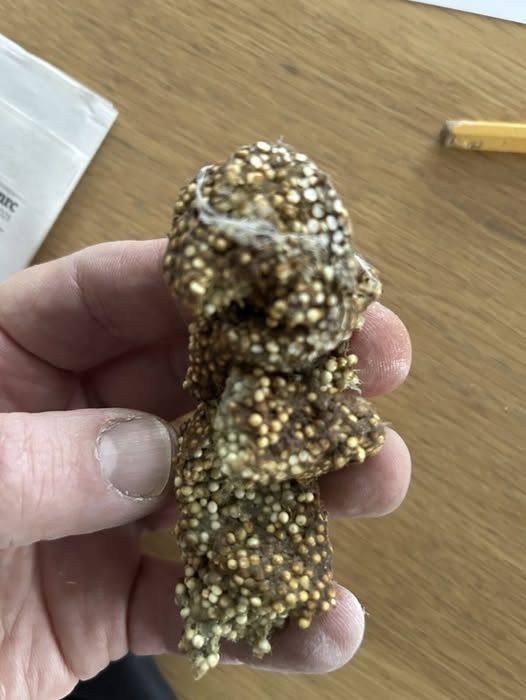
It started as a simple mission: retrieve a missing LEGO piece from beneath the bookshelf, that familiar “no man’s land” where small toys often disappear. Armed with a pencil, I carefully reached into the shadows, expecting the usual sharp plastic edges or dust-covered bricks.
Instead, I touched something unusual—lumpy, crunchy, and oddly unfamiliar at first. For a brief moment, my mind jumped to worst-case possibilities. There was no strong smell, just a faint, nostalgic scent that didn’t quite fit the situation, which only added to the confusion.
Then it became clear what it was. It wasn’t anything alarming at all—it was Floam, a long-forgotten childhood toy. For those who remember it, Floam was a colorful, bead-filled modeling material popular in the late 1990s, known for being messy, tactile, and surprisingly satisfying to shape and press into surfaces.
Holding that dried piece instantly brought back memories of simpler times—afternoons spent creating without purpose, watching cartoons, and enjoying small moments of imagination. When I showed it to my child, their reaction was more confusion than recognition, seeing it only as a strange, hardened object. But for me, it became a brief connection between past and present, a reminder of how differently joy can look across generations.