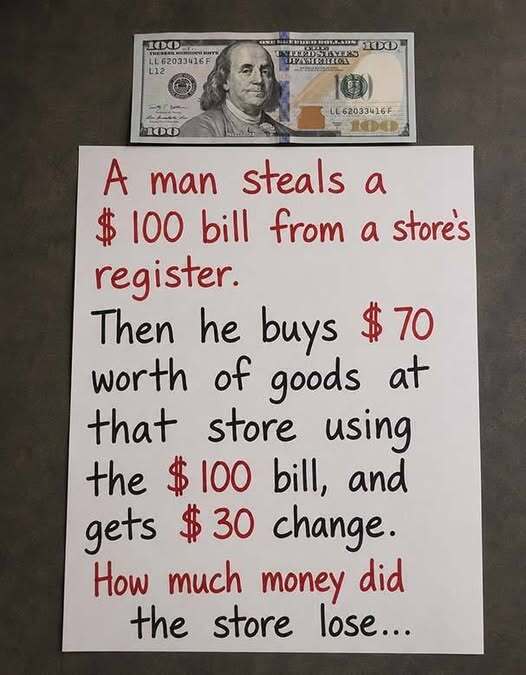
At first glance, this riddle seems very simple, and many people think they know the answer right away. However, once they begin looking at each step more carefully, the situation can become confusing. That is why this problem often leads to different answers, with some people counting the money and merchandise in more than one way.
Here is the situation: a man takes a $100 bill from a store register. Later, he returns to the same store and uses that same $100 bill to buy $70 worth of merchandise. The cashier accepts the bill and gives him $30 in change. The question is how much the store actually lost after everything is considered.
Some people answer $200 because they count both the original $100 and the merchandise separately. Others suggest $170 or $130 after breaking down each part of the transaction. The key detail is that the original $100 bill returns to the register when the purchase is made. What the store no longer has is $70 worth of merchandise and $30 in cash change.
Together, those losses add up to $100. Another way to understand it is to imagine the person simply left with $70 in products and $30 in cash. The result would be the same. The confusion comes from counting the same $100 bill twice, but the final answer remains clear: the store lost exactly $100.