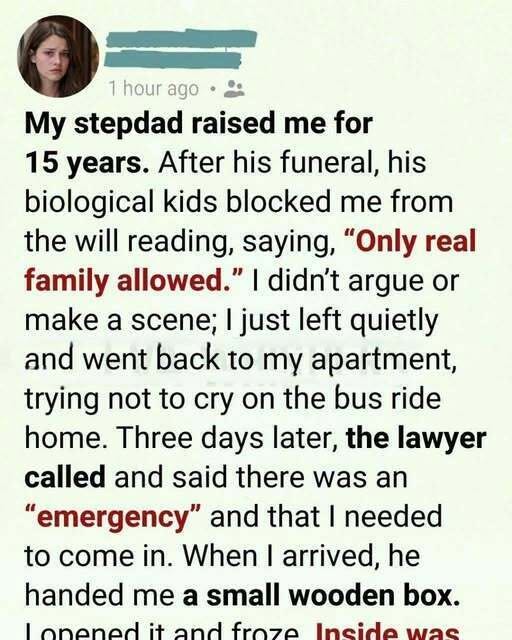
My stepfather never used the word “step” during the fifteen years he raised me. He treated me as his own child, teaching me to ride a bike, helping with homework, attending important events, and making sure I never felt different because we were not biologically related. After his death, however, his funeral focused only on his career and achievements. At the will reading, his biological children stopped me at the door and said only “real family” could enter. Heartbroken, I went home feeling as though our years together had been erased.
Three days later, his lawyer called and asked me to visit his office. He explained that my stepfather had left something specifically for me and handed me a small wooden box. Inside were photographs of us fishing, childhood certificates, and other memories he had carefully preserved. Beneath them were fifteen letters, one for every year he had raised me. He wrote about watching me grow, worrying when I became quiet, and feeling grateful for the opportunity to become my father. Raising me, he explained, had never felt like an obligation.
At the bottom of the box was a copy of his will. Contrary to what his biological children had suggested, he had deliberately divided his estate equally between them and me. The decision had been made years earlier, proving that my place in his family was intentional. The discovery overwhelmed me because those who excluded me were not speaking for him. His actions, letters, and final decisions had already made his feelings clear.
I realized that family is not always determined by genetics or legal terminology. My stepfather had chosen to be present through ordinary days, difficult moments, celebrations, and disappointments. Leaving the lawyer’s office with the box against my chest, I understood that his love had never needed witnesses. He had shown me every day that I was his child, and his final gift confirmed what I had always known: real family is built through love, presence, and commitment.