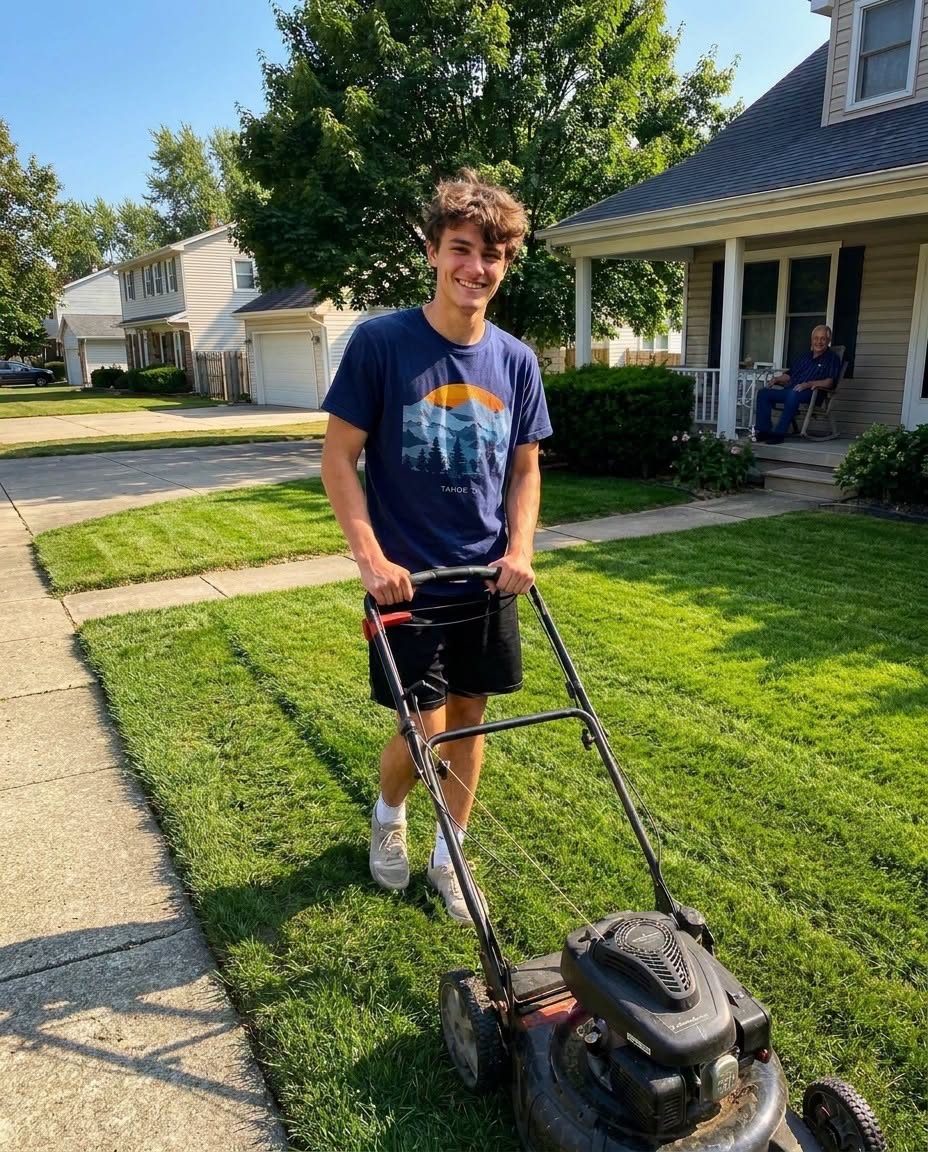
The lawyer found us in the last row of the church after Mr. Vance’s funeral. He walked directly toward my eighteen-year-old son Noah, handed him a thick envelope, and asked if he was the boy who had mowed
the old man’s lawn every Saturday. Inside were four smaller envelopes labeled “Saturday One” through “Saturday Four.” Mr. Vance had left instructions that Noah open exactly one envelope each Saturday.
His adult children, Aaron and Claire, were surprised because they had never heard about the envelopes. Noah had been helping Mr. Vance since he was fourteen, when he noticed the elderly man struggling
with his lawn mower. Although Mr. Vance’s children visited occasionally, Noah became a steady presence in his life.
Every Saturday, through different seasons and busy school days, Noah crossed the street to help without expecting anything in return.
Saturday One sent Noah and Claire to an old diner, where a woman named Ruth had been keeping a box Mr. Vance had left there. Inside were recipe cards written by his late wife, Margaret, including the
cinnamon rolls Claire remembered from childhood. Claire admitted she had stopped making them because the house no longer felt the same after her mother passed away. Saturday Two instructed Noah
to take Aaron to Franklin Field with an old baseball glove. There, Aaron discovered a letter explaining that his father had secretly watched several of his grandson Ben’s baseball games from outside the field.
Mr. Vance had avoided entering because the place brought back difficult memories of Margaret. Aaron had spent years
believing his father simply didn’t care, but the letter showed that his absence had come from grief rather than a lack of love.
Saturday Three was for Noah. The instructions told him to go to Mr. Vance’s house and look beneath the porch chair. There, Noah found a notebook filled with dates, most of them Saturdays. Mr. Vance had
recorded Noah’s visits, his progress in school, learning to drive, preparing for graduation, and even the days when he appeared tired or worried. One sentence stood out: “Need to tell him thank you properly.”
Noah had always believed he was simply helping a lonely neighbor, but the notebook showed that Mr. Vance had been paying close attention to his life. Aaron later found an entry that read,
“Boy reminds me of Aaron.” Suddenly, the family began to understand their father differently. Claire recovered a connection to her mother’s memory,
Aaron realized that his father’s distance had not necessarily meant indifference, and Noah discovered that his quiet acts of kindness had mattered deeply.
There was still one envelope left, and none of us knew what Mr. Vance had written inside. By then, however, I understood that whatever Saturday Four contained could not be more valuable than what
had already been revealed. The greatest part of the inheritance wasn’t money or property. It was the understanding that years of small, consistent acts of kindness had connected people in ways they had
never fully recognized. Noah had simply shown up every Saturday, never expecting recognition. Mr. Vance had noticed every visit and quietly preserved those memories. Sometimes, the simplest acts
of kindness become meaningful parts of another person’s life long before anyone finds the words to say thank you.