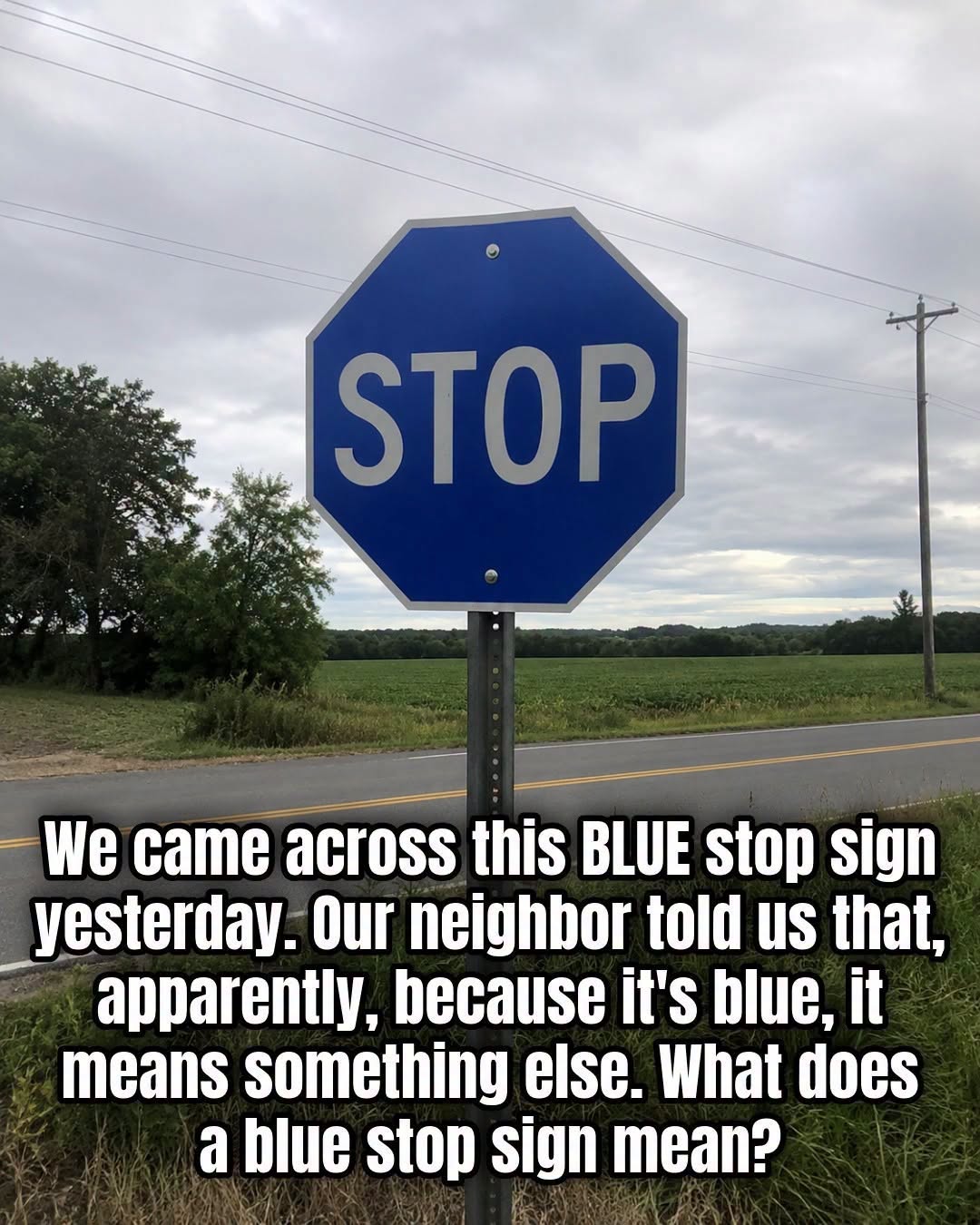
Most drivers are familiar with the classic stop sign: an eight-sided red sign with white lettering that immediately tells you to stop. Its shape and color are
so recognizable that spotting a blue stop sign can be surprisingly confusing. You might wonder whether it is an unusual traffic sign, a mistake, or something with a different purpose.
Although blue stop signs are not commonly seen on public roads in the United States, they can appear in certain private settings. Understanding why they exist can help clear up some of the confusion.
What Is a Blue Stop Sign?
In the United States, official traffic signs follow standards established through the Manual on Uniform Traffic Control Devices (MUTCD).
Standard stop signs used for public traffic control are red with white lettering and have an octagonal shape.
A blue sign designed to look like a stop sign does not follow the standard color used for official stop signs. For that reason,
blue versions are generally associated with private property, decorative purposes, or situations where an organization has chosen a nonstandard sign.
You might encounter one in a private community, parking area, business property, university campus, industrial facility, or another location where property owners use signs to direct vehicles.
Why Are Stop Signs Red?
The red stop sign has a long history. Early stop signs in the United States were not always red. Some of the earliest versions used yellow backgrounds with dark lettering because yellow was highly visible.
As reflective materials and traffic-sign technology improved, red became the preferred color. Red is strongly associated with caution, warnings, and stopping, making it an effective choice for an instruction that requires immediate attention.
Over time, the familiar red-and-white design became a consistent standard. That consistency is important because drivers can recognize the sign quickly, even when traveling through an unfamiliar area.
What Do Different Traffic Sign Colors Mean?
Traffic signs use colors and shapes to communicate information quickly. Red is commonly associated with stopping, prohibition, or other important restrictions. Yellow generally warns drivers about potential hazards or changing road conditions. Green is often used for directions and destinations, while blue is commonly associated with services, information, or guidance.
Because these colors have established meanings, a blue sign shaped like a stop sign can look unusual to drivers.
Should You Stop at a Blue Stop Sign?
If you encounter a blue stop sign, the safest approach is to stop and look carefully at the surrounding situation. It may be located on private property and intended to control traffic within that area.
Rather than assuming that an unusual color means the sign can be ignored, drivers should pay attention to the instructions provided by property owners, posted regulations, and other traffic controls.
A blue stop sign may look unusual, but it is a good reminder that road signs can sometimes vary outside the standard public-road system. The familiar red stop sign remains the standard design for official stop control in the United States, while unusual versions may be used in private or specialized environments.